


Object Record
Images
Metadata
Collection |
Canadian Harvest |
Object ID |
SH1986.024.050 |
Object Name |
Box, Wall |
Description |
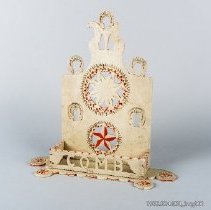
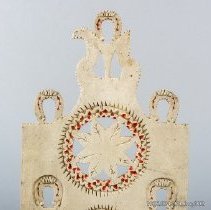
Chip carved painted wall box. White overall with red highlights. 'COMB' carved out of front piece of box. Ends of box have incised 8-pointed compass stars. Base extends out from box , scalloped edges with 8-point leaf design and small 5-point star cutout design beneath. 5 horseshoes are cut out. One on top of scroll design at top of back, the other four at the four corners of the leaf design. The piece is held together with small nails. |
Dimensions |
H-35.5 W-35 D-11.4 cm |
History |
The word Tramp originally referred to traveling artisans who went tramping on foot from job to job. These often highly skilled craftspersons, especially the woodworkers and cabinet makers, found their skills in less and less demand as the Industrial Revolution advanced, and eventually their name became associated with any jobless itinerant who searched the countryside whether for employment, a handout, or for shelter for the night. Such people were grouped together with others as undesirable vagrants and given short shrift in the Bylaws of the Town of Berlin in the 1870s. Tramps were sometimes locked up for the night and only fed after chopping a stated amount of wood, an ideal unseasonably suggested at a pre-Christmas Berlin Council meeting of 1879. Tramps and their increasingly codified behaviour are recorded in Europe, England, the United States, and Canada, as the 1800s advanced. Waterloo County's response included the tradition brought by Mennonite settlers from Pennsylvania, of the Tramp Room (Bettelmannschtub or Trampschtub). Both the Schneider Haus National Historic Site and the Peter Martin House (at Doon Heritage Village) contain a room set aside for accommodating transients. Family guests stayed in the spare room (Saubeschtub) or were given a bed in rooms shared by family members. Many Waterloo County tramps are still remembered as colourful characters who peddled horse liniment, subscribed to individual interpretations of Scripture, brought the news, and otherwise entertained or amused their hosts. The most popular of these visitors was Fred Hoffman, (1845-1926). |
People |
Hoffman, Frederick G. |