

Object Record
Images
Metadata
Collection |
Waterloo Region Museum |
Object ID |
2012.060.004 |
Object Name |
Tablecloth |
Description |
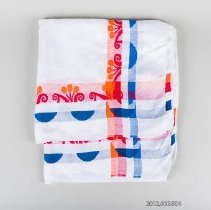
Linen damask tablecloth known as the Nationaal ontbijtlaken in the Netherlands. The tablecloth is white with an orange, red, white, and blue striped border. Floral design woven into the border. Woven in the centre of the tablecloth is a double image of the Cunera church tower and a Dutch lion stabbing a swastika with a sword. Surrounding the image is "Holland groeit weer/Holland bloeit weer/Hollands naam is weer hersteld/Holland uit het stof herrezen/Zal opnieuw ons Holland wezen/1940-1945". A small fabric label with the initials "L.K." sewn on it in red is attached to the reverse in the lower right corner. |
Date |
1947 |
Dimensions |
W-130 L-140 cm |
History |
Harry Langendoen, his parents (Jan Langendoen and Lena Stolk), and siblings (Maria, Izaak, Evert, and Adri) immigrated from the Netherlands to Canada in August of 1951. The entire family came by airplane and settled near Newmarket, ON. As the family flew here, they could not afford to bring many belongings with them. Harry married Corrie Vander Kooij, who was also an immigrant from the Netherlands. Corrie's family came to Canada in 1947 on the ship Waterman. They also settled near Newmarket where the family was involved in market gardening, which is what Corrie's father had done in the Netherlands. The items were brought by Corrie's family along with furniture and many other pieces. The stove was brought because Corrie's mother had been told that they were not available in Canada. Harry and Corrie met at Fort Erie, though their families apparently knew each other in the Netherlands but they had never met. After they married, they eventually settle in Elmira, ON in 1973. These tablecloths were designed and manufactured by S. Ferwerda from Groningen in the Netherlands. The tablecloths were manufactured to celebrate the liberation of the Netherlands at the end of the Second World War. The Cunera tower symbolized the start of the Second World War and the lion stabbing the swastika symbolized the end of the war. The tablecloths were sold in cardboard boxes with leaflets from the manufacturer explaining that he hoped the tablecloth would be used every year on national holidays and that they would become family heirlooms. The same manufacturer also made liberation tea towels. The poem on the tablecloth roughly translated means: Holland expands again Holland blooms again Dutch name is restored Holland resurrected from the dust Will Holland us again being |
Search Terms |
Second World War Nationaal ontbijtlaken |